Dev Diary #5: The Sound of Chronicles: Medieval
Join us for a closer look into the sound of Chronicles: Medieval.
Welcome to the fifth chapter of our Developer Diary Series. In our previous Dev Diary we took a closer look at Army Management, from upgrading your troops to building your army. Today, we'll explore the acoustic side of things in Chronicles: Medieval.
Normally, the sound is the part of a game that nobody talks about until it's missing. A good visual, like a detailed character or an impressive castle, gets a screenshot and a share on social media for quick likes. Good sound design cannot be captured in a screenshot and shared like a quick snack. It often gets overlooked… pardon… overheard. But strip the sound away from a game, and the illusion of a virtual world instantly collapses. To determine the quality of a sound, you need a deeper and more focused investigation, a proper meal rather than a snack. And that's what we do today: a deeper look into the sound of Chronicles: Medieval. We're also incredibly excited to introduce Knut Avenstroup Haugen, the composer behind the music of Chronicles: Medieval! To give you a first taste of his work and the musical direction we're taking, we've included four never-before-heard tracks throughout this Developer Diary.
The music is still a work in progress and subject to change, but we're thrilled to finally share some of it with you! Here's the first track! Feel free to open it in another tab and let the music accompany you as you read the rest of the diary. Enjoy.
In our game, sound isn't just a tool to create atmosphere and immersion; it´s one of the fastest, clearest ways to tell a player how they should feel before they have consciously worked out why. A dramatic shift in the music score tells you that you are about to enter a big and difficult battle; sword clangs and war cries from the side signal your flank was ambushed, or a lighthearted, peaceful song in our medieval settlements suggests relaxation and chill, letting you enjoy the moment while you are safe in that area - for now. That is the power of sound in games - it has an effect on you before you've actively decided to pay attention.
That's also our philosophy when building the sound of Chronicles: Medieval. We are not asking “what should this sound like?” - instead, our specialists are asking “what should this feel like?” Here, immersion is often the ultimate goal. To be fully absorbed as you engage with our game world. To master this challenge, we teamed up with two of the most dedicated specialists in this realm, each with a clear purpose and role. The music composer and the sound designer. Two very different disciplines working on the same goal from opposite directions.
The music composer writes the score or soundtrack, like different themes for our different cultures, adrenaline-pumping battle music, or more lighthearted pieces inviting exploration when traveling across our in-game map. Unlike movies, game scores work in one crucial way: the music responds to the players. In a movie, the composer often works against a clearly defined timeline. This is the action scene between our movie hero and the main enemy. The scene lasts 2.37 minutes, and the music needs to be composed for those 2.37 minutes with a few acoustic highlights here and there. In games, there are no clearly defined 2.37 minutes, nor 3.12 minutes or something else with a clearly defined time code. It can be anything, depending on how the player is interacting with a certain environment, and the score has to respect and support that. So the composer isn't just writing a melody; he is developing a system where the music can shift entirely or loop in different ways, adding other instruments as an additional layer when needed. It´s a richer, more powerful, and responsive system, where the different tracks react to player input in an organically believable way to maintain immersion while keeping them in harmony with each other.
Meanwhile, the sound designer builds all other sound sources apart from the music itself. And this is a lot! Think about footsteps. It's fully natural to think: “Yes, this game needs footsteps, so let's add those as sound files!” - and the job is done. Sadly, it's not that easy! Footsteps on gravel and footsteps on stone sound different. So this makes it two different types of footsteps. But there is an acoustic difference if the player is running in leather boots or plate armor boots - and those two different types of boots make different sounds on gravel or stone. Okay, so we need 4 different types of footsteps? No, the stone floor inside a castle sounds different than outside, like walking on the battlement of our stone walls. What about snow? Will snow muffle your footsteps? You see my point? It's not just about adding footsteps; it's about capturing all the different footstep variants, creating suitable sounds for each, and then building a system that ties it all together and blends between effects when applicable. And we only talked about footsteps in this example, while the world of Chronicles: Medieval has so many more sound sources, like animals, merchants, and crowds in our settlements, and all the battle sounds - there are so many sound sources with the need for their own tone! To keep immersion high, the sound designer develops solutions for each sound source and all its variants. Where the music is all about emotions, the sound design is about believability, to create an acoustic backdrop which your ear recognizes as real.
Meet the people behind the Chronicles: Medieval soundscape.
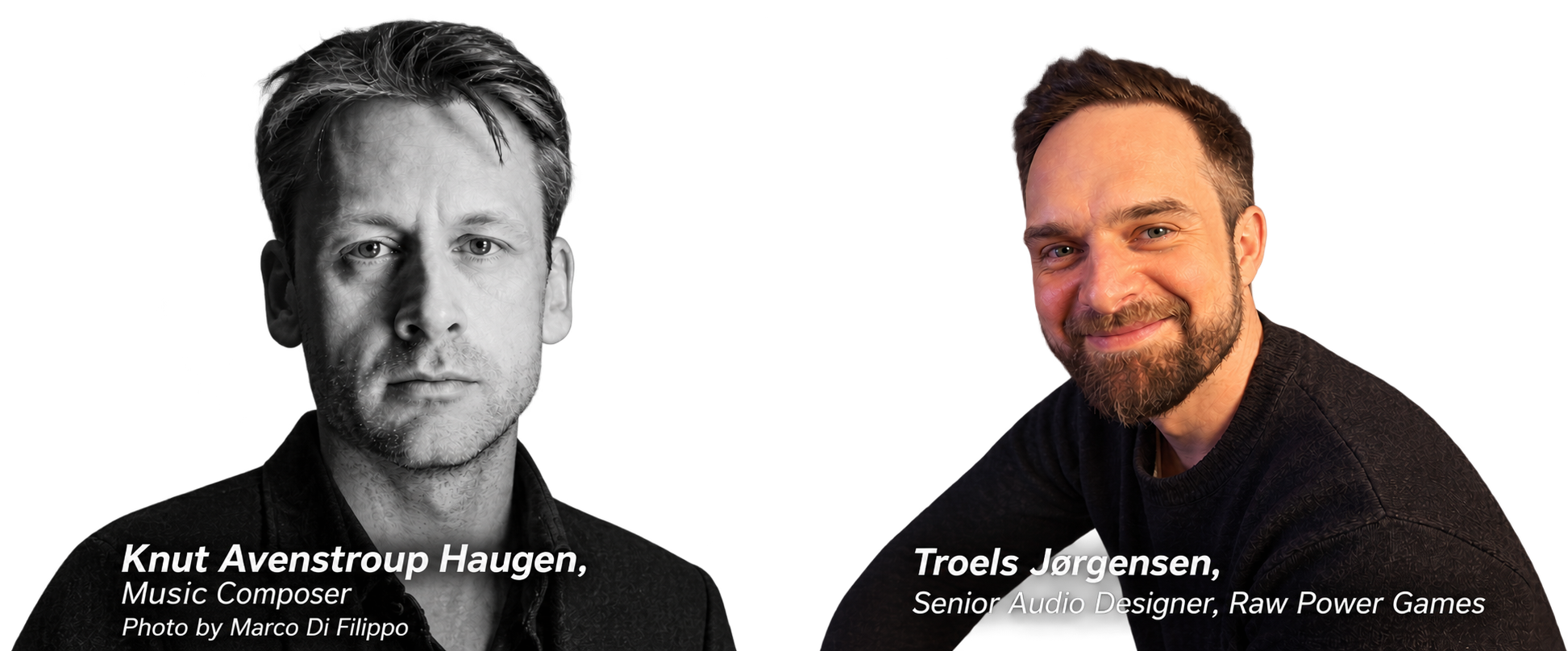
Earlier we wrote about teaming up with two of the most dedicated specialists in this realm. Big words, so who are those acoustic magicians? Let's start with the music composer: Knut Avenstroup Haugen.
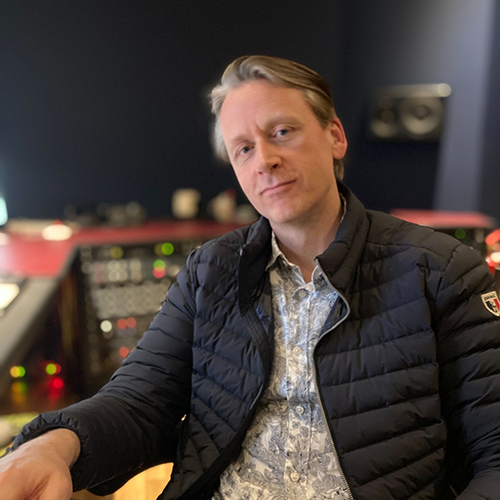
Knut studied music composition, orchestration, musicology, and Piano in the Netherlands and Norway, where he was also born. In games, he built a strong reputation with his fantastic, critically acclaimed contributions to the Conan Game Universe (Conan Exiles and Age of Conan), the two Lords of the Fallen games, and, more recently, Dune: Awakening. But Knut isn't 100% committed to Games; he's also contributed to TV productions, movies, and special events, like the World Ski Championship in Norway. With his work outside of games, he received international awards and nominations from the Hollywood Media Awards and IFMCA, the International Film Music Critics Association.
And then there is our sound designer, Troels Jørgensen, a Danish audio engineer and music producer with more than 20 years of experience. Troels studied audio engineering in Denmark and, with this background (of course!), worked at LEGO for a long time. For the animated LEGO TV Shows for Disney, Troels produced the sound for more than 70 LEGO Ninjago episodes, as well as the LEGO Star Wars releases. Between then and joining Raw Power Games, Troels did the music and sound for the Deep Rock Galactic franchise.
We sat down with Knut and Troels to interview them both about their work on Chronicles: Medieval.
When shaping the game's soundtrack, its inspirations, and its points of reference, Knut chose not to lean on a single one. The ultimate goal was to bridge two worlds: a score that felt authentic and grounded in history, yet contemporary and cinematic. Knut: To achieve this, I integrated period instruments and historical musical styles into a modern musical language and production framework. This lets the music evoke a vast, nuanced spectrum of emotion while staying authentic.
The world of Chronicles: Medieval isn't culturally homogeneous. That's a real challenge when composing a soundtrack that is vivid, varied, and historically grounded while avoiding stereotypes and cliché sounds. English – or Celtic – music could easily become stereotypical, as it’s so heavily saturated in pop culture.
Knut: The key to avoiding clichés is to bypass the Hollywood tropes and go straight to the historical sources. When you truly learn the specifics of instruments and style, like unique tunings, instrument restrictions, unique rhythmic patterns, and scales, etc., and manage to implement that into your work, the resulting music will sound fresh and sincere. As Knut puts it, the challenge here wasn't running away from clichés, but rather carving out distinct sonic borders between each culture, given how much they historically bled into one another. It became about finding the way to differentiate between them in a way that best serves the gameplay experience. As for the sounds and instruments themselves, you’re in for a real treat.
Knut: There will be a Renaissance string ensemble, a choir, tons of percussion, and many soloists. Of the soloists, the most defining are the different types of nyckelharpa, hurdy-gurdy, viola da gamba, several kinds of flutes and plucked strings, as well as vocalists. I can’t wait to tell you all more about all of this later on!
I would, however, like to point out that the work-in-progress samples you can hear today have been recorded with live nyckelharpa, its ancestor, the moraharpa, and cello nyckelharpa. All three were performed by the brilliant Erik Rydvall, who, in my opinion, is hands down the best nyckelharpa player in the world. It’s a tiny teaser of what’s to come!
Knut spent a significant amount of time researching period music and instruments. To write in a certain musical style, you must immerse yourself in it, and to write idiomatically for an instrument, you need extensive knowledge of its construction and limitations.Knut: This is especially true for primitive and period instruments. For a composer, expanding your compositional arsenal, so to speak, is incredibly exciting. The real challenge is knowing how to filter what you can use from what is less relevant. Listening to music online and continuously discovering new composers and compositions will quickly lead you down several rabbit holes!
One of Knut's biggest deep dives on Chronicles: Medieval soundtrack was mapping out unique musical identities for the game's different regions. Back then, borders shifted constantly, and neighboring countries shared deeply intertwined musical cultures.
Knut: Real history didn't offer the clean, distinct musical boundaries a video game needs. As Ridley Scott said, “I’m a storyteller – not a historian”. That became my guiding principle. Ultimately, differentiating the regions became an artistic choice rather than a strictly historical one. My job as a composer is to build a vivid, engaging illusion that serves the narrative and immerses the player. Beyond music, to create an authentic, immersive experience, environmental storytelling through sound has to extend to the sound effects layer. Cultural boundaries aren't relevant here. A cow will sound the same whether it’s French or English. So, in that sense, many sounds are completely the same, no matter the geographical location. But of course, there are ways to make the player feel the space through sound and become immersed in it.
Troels: Are you in a peasant village? Nearby a Roman church? An English castle? These things will sound different because of their surroundings. So in general I add sounds to smaller things. And the specific combination of individual sources (which can vary from location to location) dictates the overall soundscape.
All the little details that you encounter in the settlement have a distinct sound and contribute to the player experience. There are hooks that you can tap into. Like a craftsman working somewhere in the distance or the distant chatter of a crowd that you can hear somewhere to the left - that might be a clue on where to go if you’d like to buy some new gear. Troels at work:
The tavern part is interesting. We did bespoke recordings with a Danish / Swedish band called Pøbel. We value this collaboration deeply, and we decided to give it a certain feel for the music direction here.
Troels: The idea behind Pøbel was to capture the sound of a real “Medieval Tavern Music Band.” What that means: things should not be perfect! Musical hiccups are not only tolerated but even welcomed. The music should sound authentic and like it belongs in the world. And not like a polished, perfect-sounding recording. Sometimes they sing along to their instruments here and there. Sometimes they laugh and shout along. As you would hear in a real tavern, with beer involved.
This is the big, unique challenge of video game music. How do you write music that can accompany dozens - or potentially hundreds - of hours of play without becoming exhausting or overly repetitive? Knut has an answer.
Knut: The answer is variation. Any way you can create variation is good: First, you need a high volume of music so the game can switch between tracks often. The pieces themselves also need to be long and evolving to prevent immediate repetition. Beyond that, we use structural tricks: We can add or remove instruments from an arrangement and shuffle the different parts of a track. From a compositional standpoint, general exploration music needs to be somewhat anonymous. If you avoid overly aggressive hooks or elements that demand immediate attention, the music can sit comfortably in the background for hours without causing fatigue.
Knut says that he always prioritizes the most important narrative moments and defines where the score will take center stage first, since that's where the music will have the greatest impact on the players’ experience of the game.
And then there’s the big question of how “authentic” the music can be to the era. We might think we want historical accuracy, but the fact is that medieval music language simply doesn't have the vocabulary to communicate different emotional states with an audience. Historically, medieval music was highly functional and limited to religious rituals, dancing, or song accompaniment. The musical language was primitive and lacked the harmonic sophistication to express complex emotional concepts. And that is precisely what we’re aiming for.
Knut: As modern composers, we have the benefit of hindsight. We are familiar with every step of musical evolution for most cultures throughout history. We can use this knowledge to compose music that creates an illusion of a certain time and a place. Our job is to translate. We take the distinctive features of a certain style and inject them into a modern cinematic language. This lets us speak a dialect the audience understands and support narrative and emotional content while still retaining the authenticity of the time period and area.
And then, there are battles - a huge thing in Chronicles: Medieval. From the very beginning, we knew battles needed specific treatment in the music illustration. A battle can start with a handful of troops and end with thousands fighting at once. How do you take the player on that journey from anticipation to complete chaos musically? Well, that’s not a small feat. Knut: First of all, the music adapts to army size. Secondly, the battle has several phases: Preparation and planning, the start of battle (when the two sides are approaching each other), and the actual battle. Each phase has music tailored to its purpose. In addition, each culture will have its own battle music, so overall there will be a lot of battle music!
The challenge also extends to the SFX. Not every skirmish would and should sound the same. The battles vary in army size and where they happen. All that needs to be taken into account.
Troels: I basically treat a unit (a group of soldiers) as one sound source. This makes everything easier to control and reduces the number of sounds we play at the same time, saving those precious CPU cycles. Each unit has different states. Idle, running, fighting, cheering, and so on. Each state has a suitable sound. That sound is scalable in size. So a small unit of 5 soldiers won’t sound the same as a group of 100 soldiers. On top of that, you have variations. You have swordsmen, archers, horses, etc. Combined, that creates a soundscape full of grandiose moments and a decent amount of hacking and slashing.
On top of that, there are also some technical limitations to keep in mind.
Troels: To save CPU cycles, we have 2 different modes. One is when you are far away from a unit (group of soldiers). Here they play 1 sound for the whole group, signifying what they are doing (attacking, running, etc.). That's the typical audio you hear when you're the commander. Then, once you approach them and get close enough, discrete sounds start to blend in- our second mode. For instance, real discrete weapon impacts, death screams, etc. And that's often the range where you grab your sword and switch into the warrior role. Finally, as the cherry on top, we add in the voices. All the small things that add a human element to the battle. The screams, the barks, the grueling death screams.
Troels: We have different groups of voice audio in battles. Specifically, effort sounds, pain screams, death screams, and so on. Within those groups, we have a big pool of sounds that are randomly selected. That in itself creates a very believable soundscape. On top of that, we also have groups reacting to orders received. Sometimes with simple attack screams, but sometimes with real spoken dialogue. Some of these are even selected based on your faction. So a French unit will be speaking French, etc.When we talked about this, the way we’re handling sound in battles is the one thing that Troels is super proud of.
Troels: We are still working out the kinks, but I’m in general really happy with the technical underpinnings of the battles. The sound is still being worked on, but the whole system is very promising and already sounds pretty great, without being too demanding on the computer. Coming back to the soundtrack and its challenges, there’s one more thing we haven’t talked about yet: the game's sandbox nature. Chronicles: Medieval is a game where players create their own story rather than following a fixed narrative. That shapes how you compose for that kind of experience compared to a more traditional, authored story.
The fundamental difference is how much time the player spends in each area. In a linear, eight-hour cinematic game, you have a wealth of 'locked' or guided content, like cutscenes and places you only pass through once. This allows you to compose music that is more closely synchronized with the images and the narrative, with less need for track variation or systemic re-use. A sandbox game strips away that predictability completely.
Knut: Scoring this type of game with meaningful, functional music that enriches the environment and storytelling without exhausting the player is a massive challenge. The music must act as a continuous subtext, adding emotional meaning that responds to the player's choices. It has to feel intentional and authored, even though the player's journey is completely unpredictable! To round things off, we asked Knut how he would describe the sound of Chronicles: Medieval without using musical terminology, speaking only in terms of emotion. Without hesitation, he answered: Knut: I would describe it as a landscape of vivid contrasts. It is a soundscape that balances a deep sense of historical wonder and pure, fragile beauty against a heavy, looming melancholy. It captures both the warmth of human connection and the harsh, unforgiving gravity of survival in a medieval world.
We hope you enjoyed this dev diary and the samples we embedded throughout the article. This whole project is truly one that we’re passionate about. I’ll leave it up to Knut to summarize where we’re aiming to go with this on an emotional level.
Knut: Ultimately, I hope the players will remember the feeling the music gave them—the way it made the world of Chronicles: Medieval breathe and come alive. I always want the music to feel like the soul of the game; it should speak to the player about everything that cannot be seen or said, but only felt. My hope is that the soundtrack leaves them with a mix of warmth and happiness, alongside a lingering sense of bittersweet nostalgia. I hope the melodies will stick with them long after the screen goes dark, and I want them to look back and remember the music for all its instrumental colors, textures, and moods. For those who cannot wait to see more of Knut's fantastic work: next Monday, October 12, at 21.10 CEST, Norwegian national TV NRK 1is broadcasting an entire concert with some of Knut's finest compositions on their NRK 1 channel.
We hope the tracks in this blog post give you a taste of how we think a medieval sandbox should sound. We've got a fun task for you: Go listen to the "Empire Battle Theme,” as we faced a heated debate among our colleagues on how to name this track. It went all the way from the generic “HRE Battle Music” to the very questionable “Imperial Landsknecht Walzer,” we've seen a lot of title ideas, but none stuck with us. And this is where you come in.
Please go ahead and listen to the track, and let us know your title suggestions in the comments. Later, we will run a poll on Discord with the best suggestions, and the person who came up with the winning one will be added as an in-game NPC in Chronicles: Medieval! Have fun!
Until next time, as always, keep your vassals close and your lord closer!
.jpg)